Assess timing on the arterial waveform
Procedure AC3 · timing-assessment
Overview
How the clinician checks that intra-aortic balloon (IAB) inflation and deflation sit in the right part of each beat. Timing is judged on the arterial pressure (AP) waveform, never the ECG, at a 1:2 or 1:4 assist ratio so assisted and unassisted beats can be compared: inflation just before the dicrotic notch, augmented pressure (AUG) above systolic pressure (SYS), and assisted diastolic and systolic pressures lower than their unassisted counterparts. The check applies in AutoPilot™ and Operator modes.
When to perform
After triggering has been verified and the pump has started; after any change of trigger mode, timing method or settings; and whenever hemodynamics change.
Equipment
- a reliable trigger
- an AP waveform; the FiberOptix™ sensor (FOS) waveform if one is connected
Steps
Confirm triggering first: the HR display matches the patient, white markers on the ECG appear on each triggered beat and match the assist ratio, and the trigger mode shows in the Trigger tab.1
Trigger is the clock edge and timing is where inflation and deflation sit relative to it, so an unreliable trigger makes any timing assessment meaningless.
Use the AP waveform to judge timing, never the ECG or pacer trace; if a FiberOptix™ sensor is connected, assess from its waveform rather than a fluid-filled transducer.2
Inflation and deflation are defined by aortic pressure events, and fluid-filled lines have a significant delay that makes timing appear earlier than it is.
Place the IABP in 1:2 or 1:4 assist.2
Only an unassisted beat beside an assisted one shows what the balloon is adding and removing.
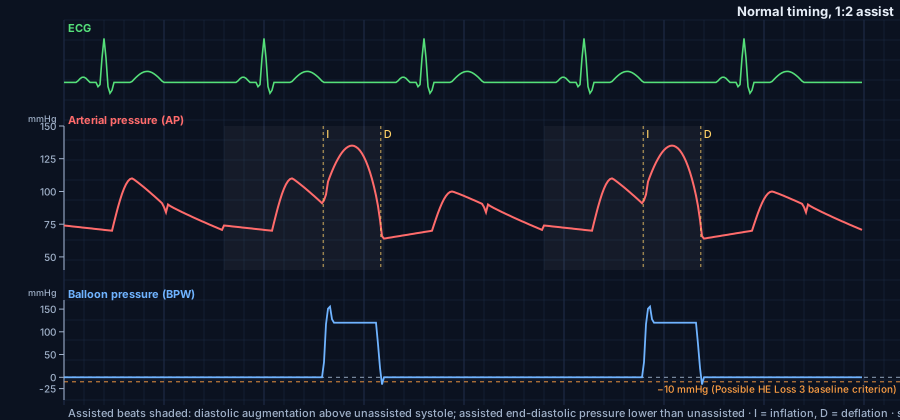
Normal timing at 1:2 — the view this step creates: one assisted beat (shaded) next to one unassisted beat, so every comparison below has a reference Verify inflation occurs just prior to the dicrotic notch.2,3
The notch marks aortic valve closure, the start of diastole; inflating there maximizes the diastolic pressure rise without obstructing ejection.
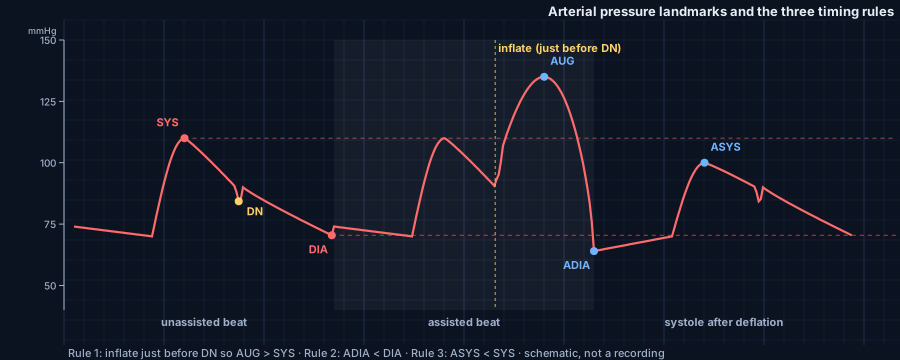
The six landmarks and the three rules, as the manufacturer's timing guide names them: inflate just before DN so AUG > SYS; ADIA < DIA; ASYS < SYS Compare AUG with SYS: AUG should be higher. If it is not, work through the reduced-augmentation causes in troubleshooting.2,3
Diastolic augmentation above the patient's own systolic peak is the visible evidence that the balloon is displacing blood effectively.
AUG (the diastolic hump on the assisted beat) should stand higher than the unassisted systolic peak beside it Compare the assisted diastolic pressure to the unassisted diastolic pressure: assisted should be lower.2,3
Deflation just before ejection drops the aortic end-diastolic pressure, which is the afterload the ventricle opens against.
Compare the assisted systolic pressure to the unassisted systolic pressure: assisted should be lower.2,3
A lower assisted systole shows the ventricle ejected against less resistance and did less work.
Recognize the error patterns: inflation before the notch (early) obstructs ejection; a gap after the notch (late) lets aortic blood run off to the periphery before it can be displaced, so augmentation falls; deflation that is late leaves the balloon inflated as the next systole begins, so the ventricle pushes against it.4,5
Timing errors reverse the benefit of counterpulsation, which is why the manual and labeling warn against chasing augmentation by moving inflation earlier.
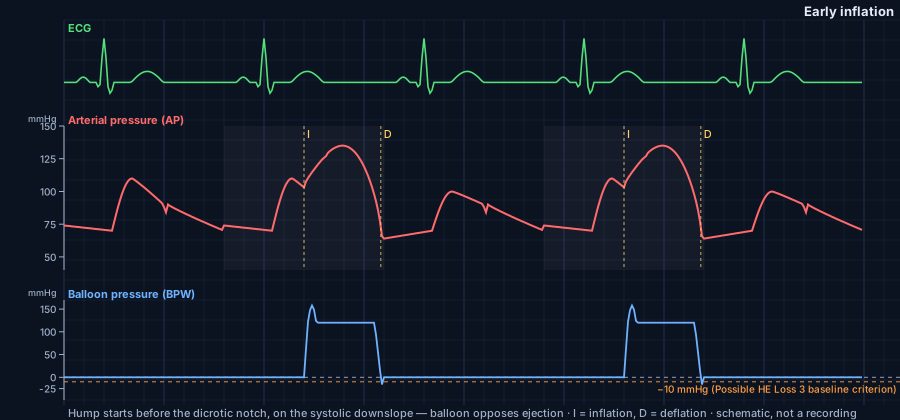
Early inflation — Hump starts before the dicrotic notch, on the systolic downslope — balloon opposes ejection 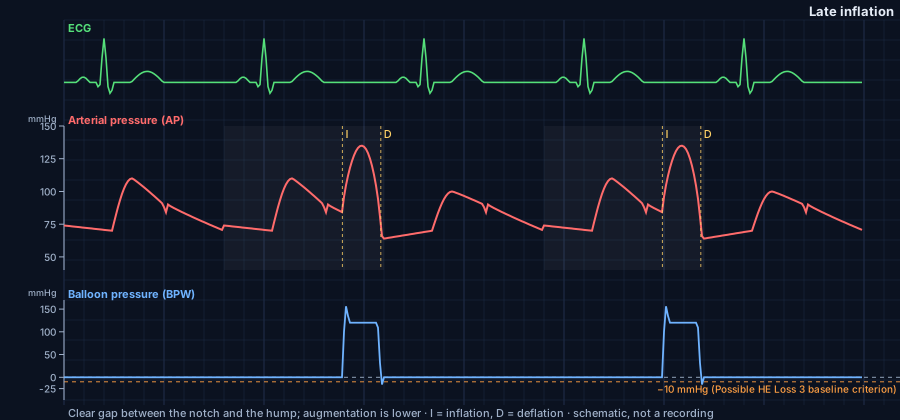
Late inflation — Clear gap between the notch and the hump; augmentation is lower 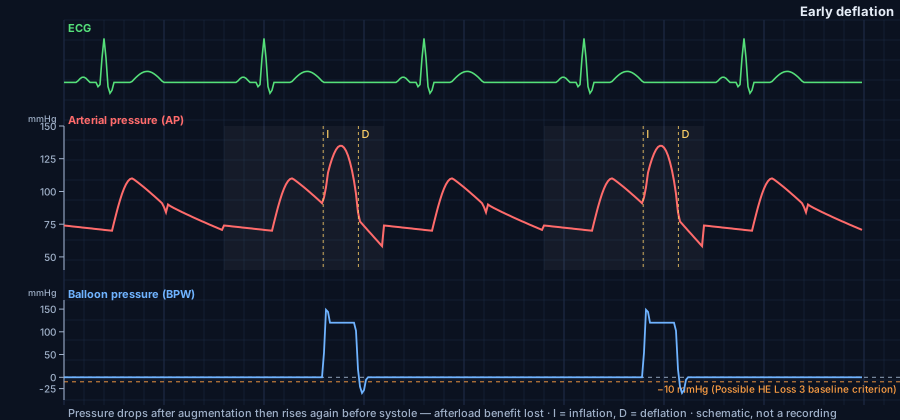
Early deflation — Pressure drops after augmentation then rises again before systole — afterload benefit lost 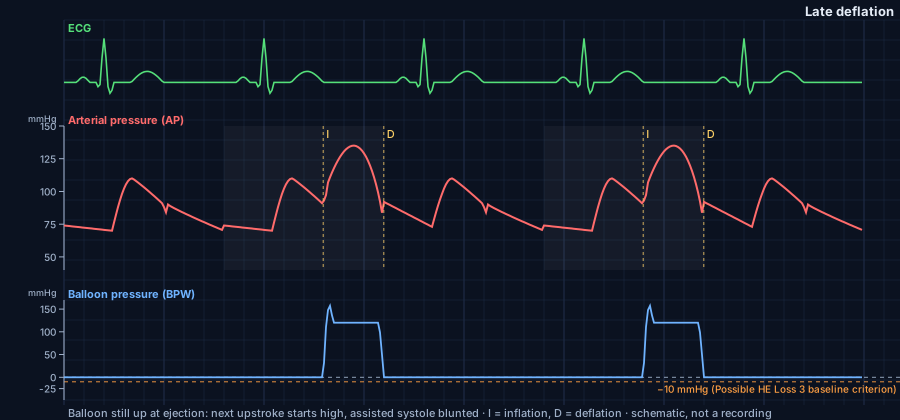
Late deflation — Balloon still up at ejection: next upstroke starts high, assisted systole blunted If timing is incorrect or AutoPilot™ does not produce optimal timing, select Operator mode and set inflation and deflation manually with the timing keys, which move the points in 1 percent of the cycle (4 ms steps in AFIB trigger), observing the effect of each change on the AP waveform.2
Timing can be changed only in Operator mode, and every adjustment must be checked against the waveform because the pump can no longer correct it automatically.
If deflation is late under R-Wave deflation, change the Deflation Timing method in the Trigger tab: AutoPilot™ (default), ALWAYS R-Wave or NEVER R-Wave.6
Real-time R-wave deflation can be hemodynamically late in some patients, and NEVER R-Wave is the escape from it.
Return the assist ratio to the ordered setting, normally 1:1 for full support.6
The reduced ratio was a diagnostic view, not a treatment setting.
Optional: print a Therapy Status report by touching the hemodynamic area and then Print.6
The report records the assisted and unassisted values and the timing settings for documentation.
Cautions
- Do not adjust timing from ECG or pacer waveforms; set inflation and deflation from the arterial pressure waveform.7
- With a FiberOptix™ sensor, assess timing from the FiberOptix™ waveform; fluid-filled transducer waveforms have significant delays which make timing appear earlier.2
- AutoPilot™ automatic timing may not suit every patient; monitor the AP waveform and, if timing is inappropriate, select Operator mode and set timing manually.8
- Do not keep moving the inflation point earlier to chase more augmentation; early inflation compromises systole.9
- If ALWAYS R-Wave is selected, monitor the patient closely; late deflation can result.6
- The white timing highlight on the AP waveform does not appear in AutoPilot™ mode or AFIB trigger mode.10
Related knowledge
- Trigger versus timing (FN-002)
- Inflation target and deflation target (FN-003)
- Timing errors reverse the benefit (FN-004)
- Judge timing on the arterial waveform (FN-013)
- Assess timing from the FOS waveform (SAF-004)
- Set timing from the AP waveform (SAF-009)
- Deflation timing selections in AutoPilot™ (TT-011)
- Timing assessment rules (TT-026)
- Assess timing from the FiberOptix™ waveform, not a fluid-filled line (TT-027)
- Six landmarks and three rules for judging timing (TT-031)
- Choosing an ECG lead for triggering (TT-032)
- Reading a normal 1:2 assisted arterial tracing (WV-001)
- Early inflation on the arterial tracing (WV-002)
- Late inflation on the arterial tracing (WV-003)
- Early deflation on the arterial tracing (WV-004)
- Late deflation on the arterial tracing (WV-005)
- Why timing is judged on the arterial trace, not the ECG or balloon trace (WV-010)
References
- Arrow International Inc. AC3™ Series IABP System Service Manual. Part No. IAM-9011, Rev 00. Reading, PA: Arrow International Inc (Teleflex); 2015. p 126.
- Arrow International Inc. AC3™ Series IABP System Service Manual. Part No. IAM-9011, Rev 00. Reading, PA: Arrow International Inc (Teleflex); 2015. p 132.
- Teleflex Inc. Arrow Intra-Aortic Balloon Pump Series: Timing Guidelines [trifold]. MC-004848 Rev 1. Wayne, PA: Teleflex Inc; December 2019. p 1.
- Arrow International Inc. AC3™ Series IABP System Service Manual. Part No. IAM-9011, Rev 00. Reading, PA: Arrow International Inc (Teleflex); 2015. p 133.
- Teleflex Inc. Arrow Intra-Aortic Balloon Pump Series: Timing Guidelines [trifold]. MC-004848 Rev 1. Wayne, PA: Teleflex Inc; December 2019. p 2.
- Arrow International Inc. AC3™ Series IABP System Service Manual. Part No. IAM-9011, Rev 00. Reading, PA: Arrow International Inc (Teleflex); 2015. p 106.
- Teleflex Inc. Arrow AC3 Safety Information: indications, contraindications, warnings, cautions, adverse events. Teleflex Interventional website. Updated April 20, 2023. Accessed October 23, 2026. Warning 43.
- Teleflex Inc. Arrow AC3 Safety Information: indications, contraindications, warnings, cautions, adverse events. Teleflex Interventional website. Updated April 20, 2023. Accessed October 23, 2026. Warning 9.
- Teleflex Inc. Arrow AC3 Safety Information: indications, contraindications, warnings, cautions, adverse events. Teleflex Interventional website. Updated April 20, 2023. Accessed October 23, 2026. Warning 40.
- Arrow International Inc. AC3™ Series IABP System Service Manual. Part No. IAM-9011, Rev 00. Reading, PA: Arrow International Inc (Teleflex); 2015. p 124.
- Arrow International Inc. AC3™ Series IABP System Service Manual. Part No. IAM-9011, Rev 00. Reading, PA: Arrow International Inc (Teleflex); 2015. pp 126-133.
- Arrow International Inc. AC3™ Series IABP System Service Manual. Part No. IAM-9011, Rev 00. Reading, PA: Arrow International Inc (Teleflex); 2015. p 226.
- Teleflex Inc. Arrow AC3 Safety Information: indications, contraindications, warnings, cautions, adverse events. Teleflex Interventional website. Updated April 20, 2023. Accessed October 23, 2026. Caution 26.
- Schreuder JJ, Maisano F, Donelli A, et al. Beat-to-beat effects of intraaortic balloon pump timing on left ventricular performance in patients with low ejection fraction. Ann Thorac Surg. 2005;79(3):872-880. doi:10.1016/j.athoracsur.2004.07.073.
- de Waha S, Desch S, Eitel I, et al. Intra-aortic balloon counterpulsation - basic principles and clinical evidence. Vascul Pharmacol. 2014;60(2):52-56. doi:10.1016/j.vph.2013.12.003.
- Teleflex Inc. Arrow Intra-Aortic Balloon Pump Series: Timing Guidelines [trifold]. MC-004848 Rev 1. Wayne, PA: Teleflex Inc; December 2019. pp 1-2.