Protective Pumping™ balloon sizing check
Procedure AC3 · balloon-sizing-check
Overview
Protective Pumping™ is Teleflex®'s name for judging intra-aortic balloon (IAB) size by pressure instead of patient height: the clinician compares the plateau of the blue balloon pressure waveform (BPW) with the augmented pressure (AUG). A properly sized balloon has the two within plus or minus 25 mmHg; a plateau more than 25 mmHg above AUG suggests an oversized, occlusive balloon, and the brochure target is 90 to 95 percent occlusive.
When to perform
After triggering, timing and BPW shape have been assessed at start-up; after any balloon volume change; and whenever HIGH PRESSURE alarms or a squared BPW raise the question of an occlusive balloon.
Equipment
- pump running with a stable AP waveform and AUG value
- the horizontal cursor (keypad up and down keys)
Steps
Complete the triggering, timing and BPW shape assessments first, with the pump running.1
The plateau-to-AUG comparison assumes a correctly timed, normally shaped BPW; a kink or leak distorts the plateau before size has anything to do with it.
Use the cursor key to place the horizontal cursor line on the flat plateau of the blue BPW.2
The plateau is the pressure inside the fully inflated balloon, which is what is being compared to the aorta.
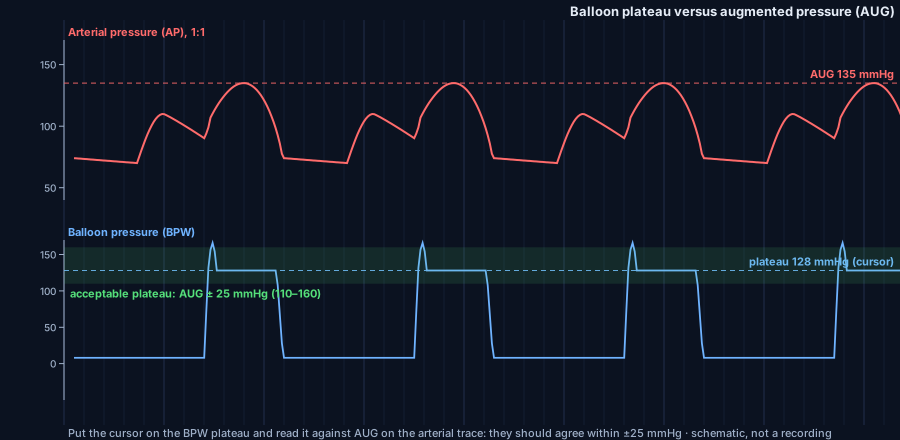
Cursor on the plateau, read against AUG: agreement within ±25 mmHg means the full balloon is feeling the pressure it is supposed to raise Read the BPW plateau pressure from the cursor measurement value at the extreme right of the cursor.2
The cursor gives a number rather than an eyeball estimate against the scale.
Read AUG from the hemodynamic display and compare it with the plateau value.2
The IAB is properly sized when AUG and the BPW plateau are within plus or minus 25 mmHg of each other.
If the BPW plateau is more than 25 mmHg higher than AUG, the IAB may be too large for the patient; consider reducing the IAB volume, which may require a physician order, in 0.5 cc steps.1
An occlusive balloon pressurizes its own helium above the aortic pressure it is displacing, and an oversized balloon raises the risk of rupture, thromboembolism, thrombocytopenia, hemolysis and visceral compromise.
If the plateau is within plus or minus 25 mmHg of AUG but AUG is much lower than SYS, work through the reduced-augmentation causes: the IAB may be too small (consider a larger IAB if more support is required) or not correctly positioned (check position and reposition as needed).1
Pressure agreement with poor augmentation means the balloon is not occlusive enough to displace a useful volume, or is displacing it in the wrong place.
Judge the result against the brochure target of 90 to 95 percent occlusive and adjust volume accordingly.3
Height and body-mass index correlate poorly with aortic length, so pressure is the manufacturer's recommended basis for sizing.
Recheck the plateau against AUG after any volume change and confirm the IAB volume is as ordered by the physician.4
A changed volume changes the plateau, and the start-up checklist asks for both sizing and volume to be verified.
Cautions
- Reducing IAB volume for an oversized balloon may require a physician order.1
- If the IAB is suspected occlusive, do not reduce volume below 2/3 (66 percent) of the balloon's capacity; pump at full capacity for 5 minutes every 1 to 2 hours; consider a smaller IAB.5
- If the BPW does not resemble a normal or acceptable waveform, take immediate action to correct a potentially unsafe condition.1
- Changing IAB volume while pumping momentarily suspends support until APPLY; ensure the patient tolerates it.6
Related knowledge
- Protective Pumping™ occlusivity target (AG-015)
- Height predicts aortic length poorly: Protective Pumping™ (FN-017)
- Minimum balloon volume 2/3 of capacity (SAF-011)
- BPW plateau versus AUG (TS-019)
- Three causes of a squared BPW (TS-020)
- Managing an occlusive IAB (TS-022)
- Balloon volume adjustment and connector recognition (TT-028)
- Balloon sizing by AUG versus BPW plateau (TT-030)
- The normal balloon pressure waveform (WV-006)
- Squared or high-plateau balloon pressure waveform (WV-007)
References
- Arrow International Inc. AC3™ Series IABP System Service Manual. Part No. IAM-9011, Rev 00. Reading, PA: Arrow International Inc (Teleflex); 2015. p 134.
- Arrow International Inc. AC3™ Series IABP System Service Manual. Part No. IAM-9011, Rev 00. Reading, PA: Arrow International Inc (Teleflex); 2015. p 136.
- Teleflex Inc. Arrow® AC3 Optimus® Intra-Aortic Balloon Pump: IABP Performance Evolved [brochure]. MC-005536 Rev 0.1. Wayne, PA: Teleflex Inc; August 2019.
- Arrow International Inc. AC3™ Series IABP System Service Manual. Part No. IAM-9011, Rev 00. Reading, PA: Arrow International Inc (Teleflex); 2015. p 106.
- Teleflex Inc. Arrow AC3 Safety Information: indications, contraindications, warnings, cautions, adverse events. Teleflex Interventional website. Updated April 20, 2023. Accessed October 23, 2026. Warning 33.
- Teleflex Inc. Arrow AC3 Safety Information: indications, contraindications, warnings, cautions, adverse events. Teleflex Interventional website. Updated April 20, 2023. Accessed October 23, 2026. Caution 18.
- Arrow International Inc. AC3™ Series IABP System Service Manual. Part No. IAM-9011, Rev 00. Reading, PA: Arrow International Inc (Teleflex); 2015. pp 134-137.
- Arrow International Inc. AC3™ Series IABP System Service Manual. Part No. IAM-9011, Rev 00. Reading, PA: Arrow International Inc (Teleflex); 2015. p 191.
- Teleflex Inc. AC3 Optimus™ Intra-Aortic Balloon Pump (IABP) With FiberOptix™ Sensor Technology: Product Specifications. MCI-2025-0998 Rev 0. Athlone, Ireland: Teleflex Medical Europe Ltd; July 2025.