Helium leak test: find which side of the clamp is leaking
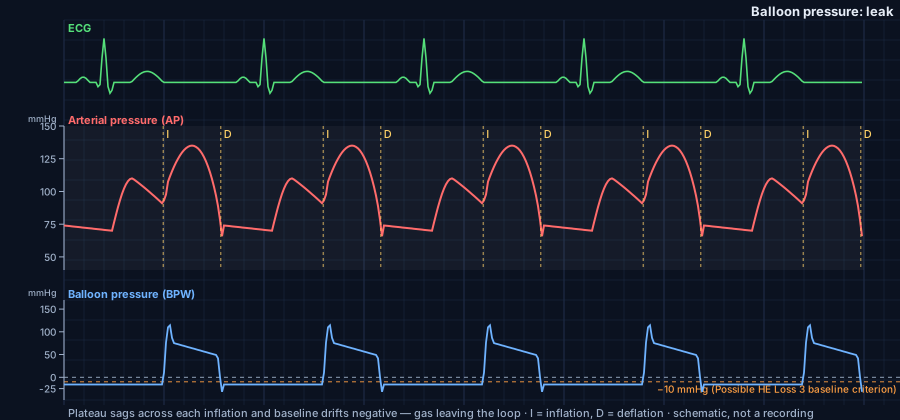
What to do after Possible HE Loss 2, Possible HE Loss 3 or LARGE HE LEAK, or a helium tank that drains too fast. Clamp the driveline, pump against the clamp, and watch the balloon pressure baseline: if it falls, the leak is on the pump side of the clamp.
The console clinician runs this test under constant observation. Any blood in the tubing ends the test at stage 1.
-
1
Look for blood before anything else
Blood in the tubing, even rust-colored flecks or coffee-ground material? Stop here. Disconnect the IAB connector from the pump, clamp the tubing, do not resume pumping, call the physician and prepare to remove the IAB.1
Do
Expect
If not
- Blood seen
- The balloon membrane has breached. Pumping helium into it risks gas embolism. Do not resume pumping.1
-
2
Get ready and suspend the pneumatic alarms
-
3
Clamp 1: patient side off, pump against it
Baseline steady? The pump side holds gas, so the leak is probably on the patient side: the catheter or the balloon. Consider stopping, removing the catheter and inserting another. Baseline falling? Go to stage 4.3
-
4
Clamp 2: move the clamp next to the console
Baseline still falling? The leak is in the pump or at the IAB volume connector. Go to stage 5.3
Do
Expect
- With almost all the tubing clamped off, only the console and the connector joint are left as the source.3
If not
- Fell at clamp 1 but steady at clamp 2
- The leak is in the driveline between the two clamp positions. The manual doesn't spell this out; it follows from where the clamps sit. Check that tubing and the quick connect as in stage 5.3
-
5
Fix the connector side, then test again
Baseline steady on retest? The leak is fixed; resume pumping and go to stage 7. Still falling? Go to stage 6.3
Do
- Check the O-rings on the balloon connector and wipe away debris.3
- Make sure the quick connect at the IAB bifurcation is tight; look for stretched tubing at the connector and catheter junction.3
- If O-rings are damaged or missing, replace the driveline tubing to the connector with one of the same size (color).3
- Repeat: alarms off, clamp, pump on, watch.3
Expect
- A steady baseline after the repair.3
If not
- Replacement connector is a different color
- Don't use it. A different size code changes the balloon volume the pump delivers.3
-
6
-
7
- ✓
Leak fixed, alarms back on
References
- Arrow International Inc. AC3™ Series IABP System Service Manual. Part No. IAM-9011, Rev 00. Reading, PA: Arrow International Inc (Teleflex); 2015. p 215.
- Arrow International Inc. AC3™ Series IABP System Service Manual. Part No. IAM-9011, Rev 00. Reading, PA: Arrow International Inc (Teleflex); 2015. p 190.
- Arrow International Inc. AC3™ Series IABP System Service Manual. Part No. IAM-9011, Rev 00. Reading, PA: Arrow International Inc (Teleflex); 2015. p 218.
- Arrow International Inc. AC3™ Series IABP System Service Manual. Part No. IAM-9011, Rev 00. Reading, PA: Arrow International Inc (Teleflex); 2015. p 181.
- Arrow International Inc. AC3™ Series IABP System Service Manual. Part No. IAM-9011, Rev 00. Reading, PA: Arrow International Inc (Teleflex); 2015. p 220.
- Teleflex Inc. Arrow Intra-Aortic Balloon Pump Series: Timing Guidelines [trifold]. MC-004848 Rev 1. Wayne, PA: Teleflex Inc; December 2019. p 1.
- Arrow International Inc. AC3™ Series IABP System Service Manual. Part No. IAM-9011, Rev 00. Reading, PA: Arrow International Inc (Teleflex); 2015. p 108.
- Arrow International Inc. AC3™ Series IABP System Service Manual. Part No. IAM-9011, Rev 00. Reading, PA: Arrow International Inc (Teleflex); 2015. pp 215-221.
Learn IABP · Not a substitute for the Operator's Manual, the IAB catheter Instructions for Use, or institutional training.